As the political tensions create division throughout America, this friction isn’t staying at home, it’s transferring to classrooms. Experienced first hand, I’ve watched tears shed from TPHS students navigating this era of uncertainty, mourning their community members, and fellow Americans. Although politics have mostly remained outside of public school classrooms, the magnitude of the current political climate isn’t remaining on the outskirts any longer. Students are experiencing strong emotions as they watch their country rapidly change, and they aren’t sure how to handle it.
Students wake up and most immediately check their phones. They open Instagram or TikTok and they’re faced with videos of ICE raids, assaults, and even homicides. Instantly after waking up, their brain is clouded with strong emotions. Students then go to school, hoping to do well on their assignments and tests. But, after hearing directly from students, they can’t focus. Their grades are suffering, and it’s not from a lack of discipline.
Sophomore Student A, explains, “I’ve personally had a hard time focusing, especially knowing that there are children worried every single day about being torn away from their families…it’s hard to be focused on learning when I know that there is someone out there that needs help, and I personally can’t do anything to help them as a fifteen year old.” This sparked my interest- are other teens in the TPHS student body struggling with staying focused, struggling with feeling hopeless?
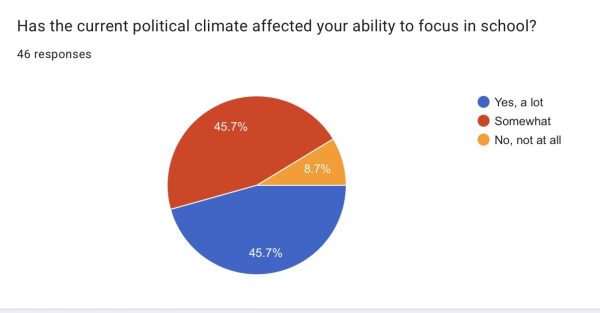
I created a google form, asking any willing student to answer questions about how they’re feeling, while balancing school and the emotions experienced from the current political environment. Out of 46 responses, 45.7% of students answered that the current political climate has strongly affected their ability to focus in school, 45.7% explained feeling that politics have somewhat affected their focus, and only 8.7% explained that the current political situation has not at all impacted their ability to focus.
When asked if this inability/ability to focus in school has negatively impacted their grades, 21.7% answered that their inability/ability to focus has strongly caused their grades to suffer, 43.5% said this inability/ability to focus has somewhat caused their grades to suffer, and 34.8% stated that their inability/ability to focus has not at all caused their grades to suffer.
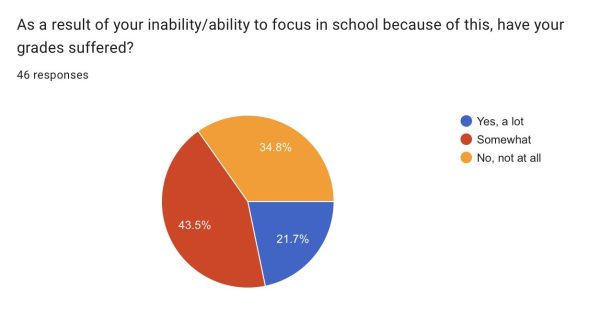
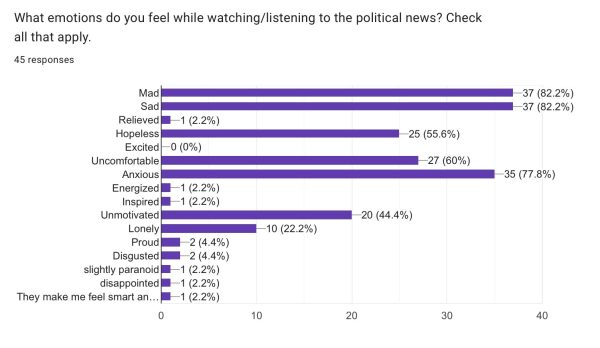
These numbers show that the current shift in politics has directly impacted many students’ school day, and for some, their grades. Not only were these two questions asked but students were told to select any emotion that they have felt while indulging in political news. This poll also contained a spot to add their own emotions, if not listed. Out of 45 responses the top selected were: mad (82.2%), sad (82.2%), anxious (77.8%), uncomfortable (60%), hopeless (55.6%), unmotivated (44.4%) and lonely (22.2%).
Included in the google form was an option to add anonymous comments, discussing more direct feelings. Here is what students had to say:
- “Seeing what’s going on in our country genuinely upsets me to the point where I fear for my future and am losing the passion I once had for school.”
- “Very disappointed.”
- “I’m worried about ICE affecting my friends, also I’m increasingly worried about our tensions with other nations, such as Greenland.”
- “The current political climate has directly affected my family, with my relatives being targeted and told they need to ‘prove their citizenship.’”
- “I hope the Trump administration stops with all the ICE raids and kidnapping my people.”
Also included in the form was an option to leave your name and email to be directly interviewed. I asked willing students similar questions on the google form as well as some additional questions, picking their brains.
When asked about how the tense political climate has affected her ability to focus, sophomore Student B states, “I feel like it has because, honestly, the news follows you everywhere. You go to school, people are talking about it. You go home, people are talking about it. And with social media and everything, you don’t really escape it.” This idea of the failure to avoid the pressing political issues is exhibited throughout almost every student interviewed. “I’ve just felt very unmotivated recently, because every time I open my phone, we’re constantly grieving someone else, it’s just saddening to see…” says Student A. Hearing from these students directly has made it clear that social media has played a huge role in reminding students of everything going on in the country. This burden of constantly being followed by the news is a cornerstone in students’ motivation and ability to do well in school.
When asked about if her inability to focus has impacted her grades/motivation Student B responds, “I feel like it has because something like school work feels small when you’re bombarded with everything that is happening. Everyday things start to feel not as important.” Not only is it crucial to find out why these students are feeling burnt out, and emotional but also, finding what it is that is helping them cope. An anonymous student tells us, “Everyday in my AP American History class, we talk about current events.” When asked how these conversations make them feel they state, “I feel like sometimes it calms my nerves because I feel not alone anymore.” When asked a similar question Student A tells us, “I definitely think there’s a good handful of people that feel the same way that I do. I think there’s a lot of young people that are really frustrated with what’s going on.” Similarly, junior Student C, discusses whether or not she feels validated for her feelings at school. She states, “I’m seeing other people’s opinions agreeing with my opinions on it, so I believe that is so much better than just being the odd one out and having other people think it’s wrong.”
Although the majority of students who participated in the survey as well as volunteered to be interviewed seemed to have a more negative attitude towards the current situation, a small number felt a positive connotation, but did not leave comments or information to contact them further. In every interview, students describe feeling the need for community and validation. Because students spend so much time at school, many yearn for school to contain some of that necessary stress relief. Encouraging students to join extracurriculars to pass their time as well as give them a community is important. Validating their feelings, and allowing them to have a community within the school is necessary. The facts are illustrated, politics are affecting student emotions and motivation. Students need community, support, and conversation. It is up to us to validate all students, no matter their beliefs, through this stressful time.
Additional Resources:
For more information not directly related to TPHS students, check out these links:
- Extracurriculars & Youth Mental Health
- Teens who participate in extracurricular activities have better mental health
For a media bias chart check out this link:
Photo Credit: Boss 1000/Wikimedia Commons